
The Habit You Look Forward To
For a long time I thought habits were a problem of willpower — that if I just gritted my teeth hard enough, the behavior would hold. Then I noticed something inconvenient: the habits that stuck weren't the ones I forced. They were the ones I looked forward to.
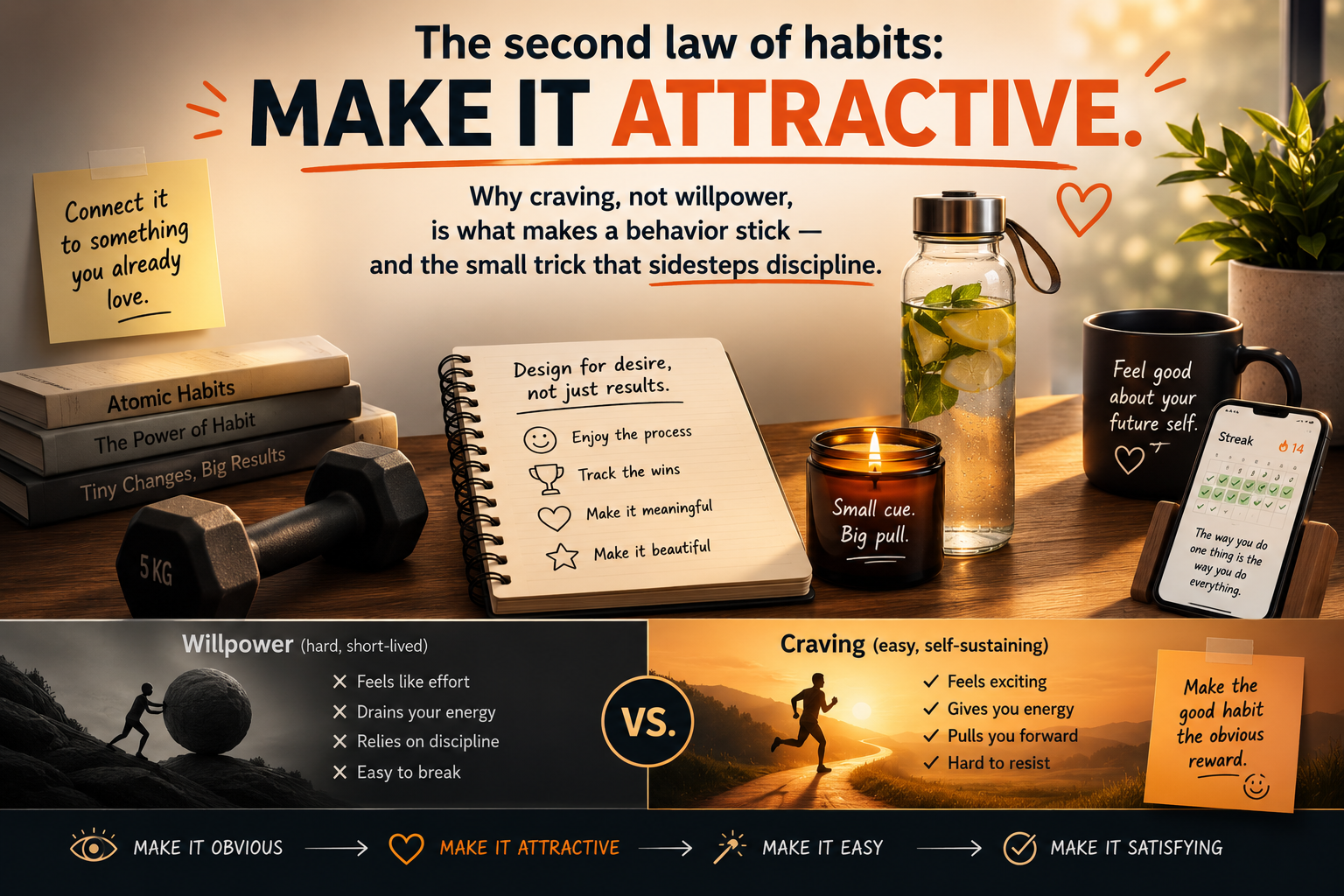
James Clear's second law is exactly this — make the habit attractive. And here psychology weighs more than discipline. The dopamine we associate with pleasure is released less at the reward itself than in the anticipation of it. The brain rewards the chase, not the catch. Craving is the fuel; the result is just the receipt.
That explains why so many „rational" plans fall apart. You know you should run, you know it's good for you — but nothing in you wants it at 6 a.m. A plan handles the what and the when (I wrote about that separately), but it never touches whether you actually feel like doing it.
The trick that worked for me is what Clear calls temptation bundling: you allow yourself something you want only while doing something you need. My simplest version was headphones. One podcast I genuinely love, I let myself hear only while walking. The walk didn't become pleasant on its own — it borrowed the pull of something else. After a few weeks I wasn't fighting the decision anymore; I missed the story, and discipline had nothing to do with it.
There's a quieter version of the same thing — the language you wrap around the habit. „I have to" and „I get to" point at the identical action but set up different anticipation. A small swap, but the dopamine system listens to the framing, not just the facts.
As an engineer I'm used to thinking in systems: if the output isn't what you want, the problem is usually the input, not the operator. Willpower is an expensive, unreliable input. Attractiveness is cheaper and steadier — once it's wired in, it runs while you sleep.
Discipline gets you to do something once. Craving gets you to come back. Durable habits don't run on willpower — they simply became the thing you look forward to.
Comments (0)