
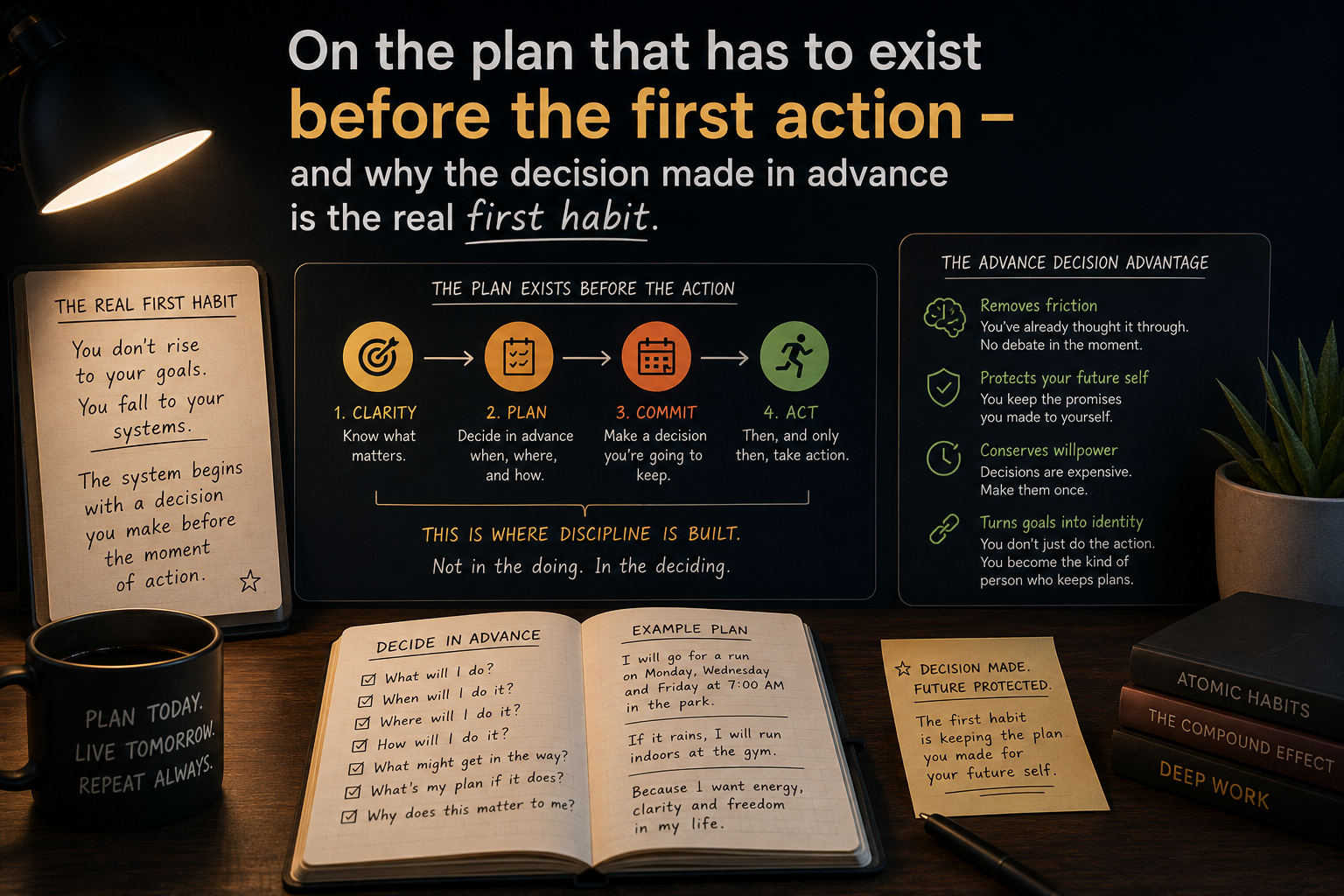
The Habit Before the Habit
Every time I've tried to start a new habit on motivation alone, I've failed within days — no matter how strongly I wanted the change. The problem was never a lack of desire. The problem was the moment of execution: standing in front of a decision that has to be made in real time, right when motivation is losing to fatigue, distraction, or a plain "not now."
In Atomic Habits, James Clear cites psychologist Peter Gollwitzer's research on implementation intentions. The difference between people who actually follow through and people who only intend to isn't usually willpower — it's the specificity of the plan. A vague intention ("I'll exercise more") almost never turns into behavior. A specific plan ("I'll exercise Tuesday at 7am at the gym near my apartment") turns into behavior noticeably more often.
Clear formalizes this as: "I will [BEHAVIOR] at [TIME] in [LOCATION]." Habit stacking, which I wrote about in an earlier post, is a variant of the same idea — instead of time and place, the anchor is another habit already in place: "After [CURRENT HABIT], I will [NEW HABIT]." In both cases the mechanism is identical: the decision gets made once, in advance, instead of being re-litigated every day at the moment of action.
In practice the difference between the two approaches looks like this: "I'll write more" versus "I'll write for 20 minutes at 6:30am, before coffee, at the kitchen desk." The first is a wish. The second is an instruction I can execute without thinking — precisely because I've already worked through everything hard about it in advance: when, where, for how long, what needs to be ready. When the moment arrives, the only decision left is whether to press "start" on something whose shape I already know.
As a backend engineer, this idea sounds familiar from somewhere else entirely. Every decision you leave open at runtime — every if evaluated in the moment — is a point where something can fail. That's why configuration gets written ahead of time instead of improvised on every call. A function's contract is defined once; invocation just executes it. A habit plan works the same way — instead of deciding "whether and when" fresh every day, you define it once as configuration and simply run it.
The reason this works comes down to a limited resource: attention and willpower in the present moment. When the decision has already been made in advance, there's nothing left to decide at execution time — only something left to do. That's the difference between "should I go" and "this is the moment I already decided on." The second requires far less effort, because the effort of deciding was already spent — earlier, in a calmer moment, away from the resistance of right now.
Clear's two-minute rule works best exactly in combination with a plan like this. It's not enough to know you want to read more — the book has to be on the nightstand, not on a shelf in another room. The plan isn't just "when" — it includes an environment arranged so the action is the easiest possible thing to do, at that specific time and place.
There's a subtler layer here too. The act of planning is itself a small vote for the identity you're building — before the habit has even been performed once. Sitting down and writing "I will do X at Y time in Z place" already makes you think of yourself as someone who has a plan for this. It's the first step of the identity-based approach I've written about before, just happening earlier than we usually imagine.
In SamsaraForge, the habit-tracking platform I'm building, this principle is built into the mechanics directly, not bolted on as a reminder. Every habit is defined with a specific trigger — a moment and a context — before it can even be marked complete for the first time. The idea is that the app walks you through the same planning process Gollwitzer's research shows actually works, instead of just hoping you'll remember.
So I no longer think of the plan as preparation before the habit. I think of it as the habit's first real execution — the hardest part, done in advance, at a moment when I have the energy and clarity for it. Everything after that is just running a decision I've already made.
A habit doesn't start with the first action. It starts with the decision made in advance that makes the action almost inevitable.
Comments (0)