
Habits as a System: The Four Laws of Behavioral Change
I keep rereading James Clear's Atomic Habits, and one framework in it stops me every time. Not because it's new, but because it describes human behavior in a way that looks suspiciously like what I work with in code every day.
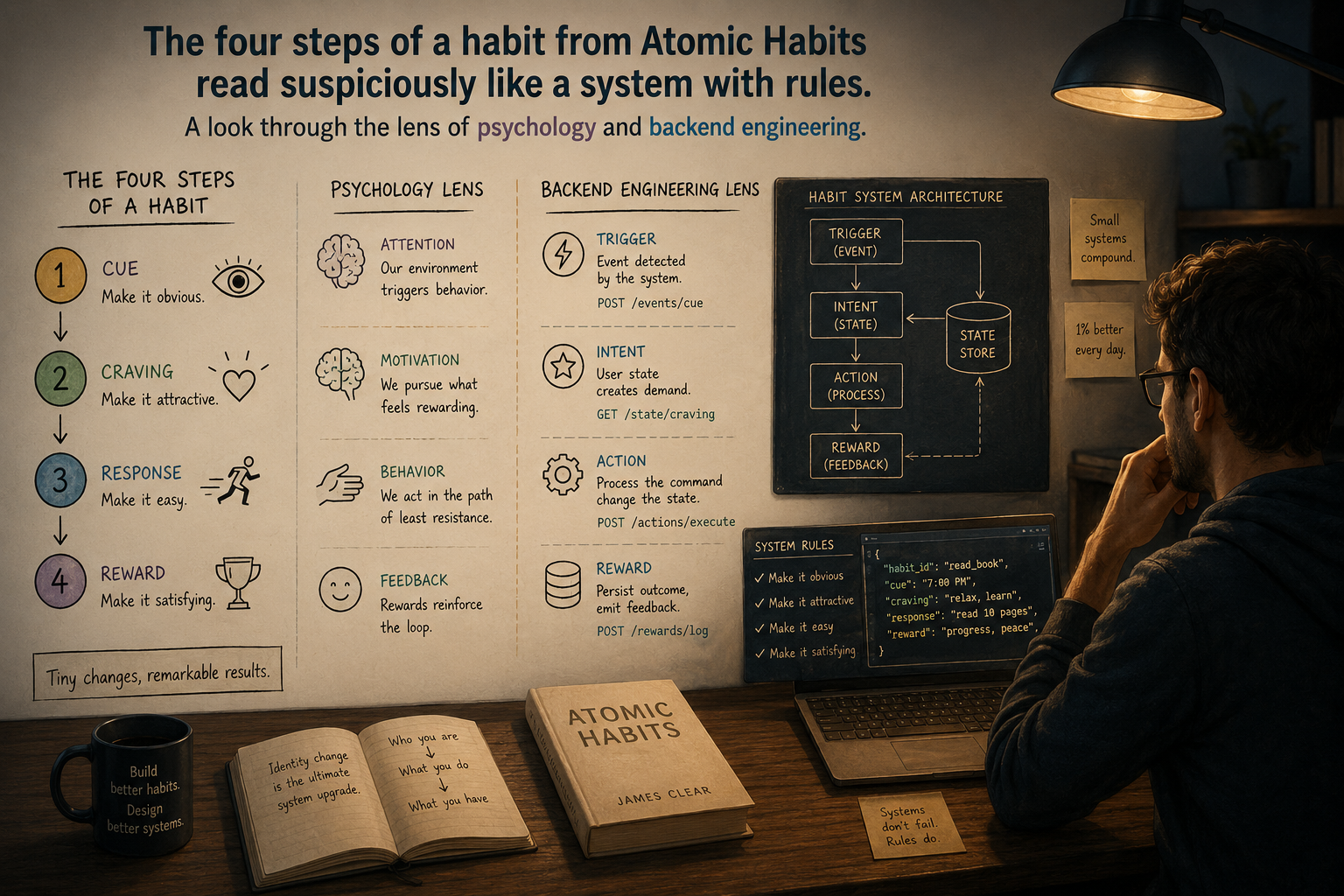
Clear breaks a habit into four steps — cue, craving, response, reward. The cue triggers, the craving motivates, the response is the action itself, and the reward closes the loop and tells the brain what's worth remembering. Repeated often enough, the behavior sinks below conscious awareness and runs on autopilot.
Clear himself draws a comparison that grabs me: every system has a set of rules that govern its behavior — an algorithm governs a piece of software, a standard operating procedure governs a company's employees, the laws of physics govern the universe. Habits are simply the rules by which our own behavior runs. For someone who writes backend services and also carries a background in psychology, that isn't a metaphor — it's almost a literal description.
The interesting part comes when he turns the four steps into four levers. To build a good habit: make it obvious, attractive, easy, satisfying. And the most elegant bit — to break a bad one, you just invert each lever: invisible, unattractive, difficult, unsatisfying. The same system, the same four points of leverage, only running in reverse.
What psychology adds on top of the framework's engineering tidiness is humility. You don't change your behavior through willpower; you change it by rearranging the environment so the right action sits along the path of least resistance. Willpower is an expensive resource; good architecture spends less of it. Exactly as in code — if you rely on discipline every time to avoid repeating the same mistake, the bug is in the system, not in you.
When I built SamsaraForge, I didn't want these four laws to be mere inspiration in some intro. I built them into the mechanics themselves — the cue, the ease, and the feedback are part of how the product works, not advice the user has to remember on their own.
A habit isn't a question of character but of design. Change the system and the behavior follows — just as good code makes the right thing easy and the wrong thing hard.
Comments (0)