
Visible Habits: Design the Environment, Not the Willpower
When code behaves differently on two machines, the code itself is rarely at fault. It's almost always the environment — a different config, a missing variable, another version of a dependency. Same code, different context, different behavior.
Habits turned out to work the same way. For a long time I read every dropped routine as a defect of will — a shortage of discipline. Then I started looking at the environment I was "running" in, and the explanation shifted.
Psychology has known this for ages. Behavior isn't a function of the person alone, but of the person and the situation. Kurt Lewin wrote it down eighty years ago as B = f(P, E) — behavior is a function of the person and their environment. We just find it more comfortable to credit character for everything and the surroundings for almost nothing.
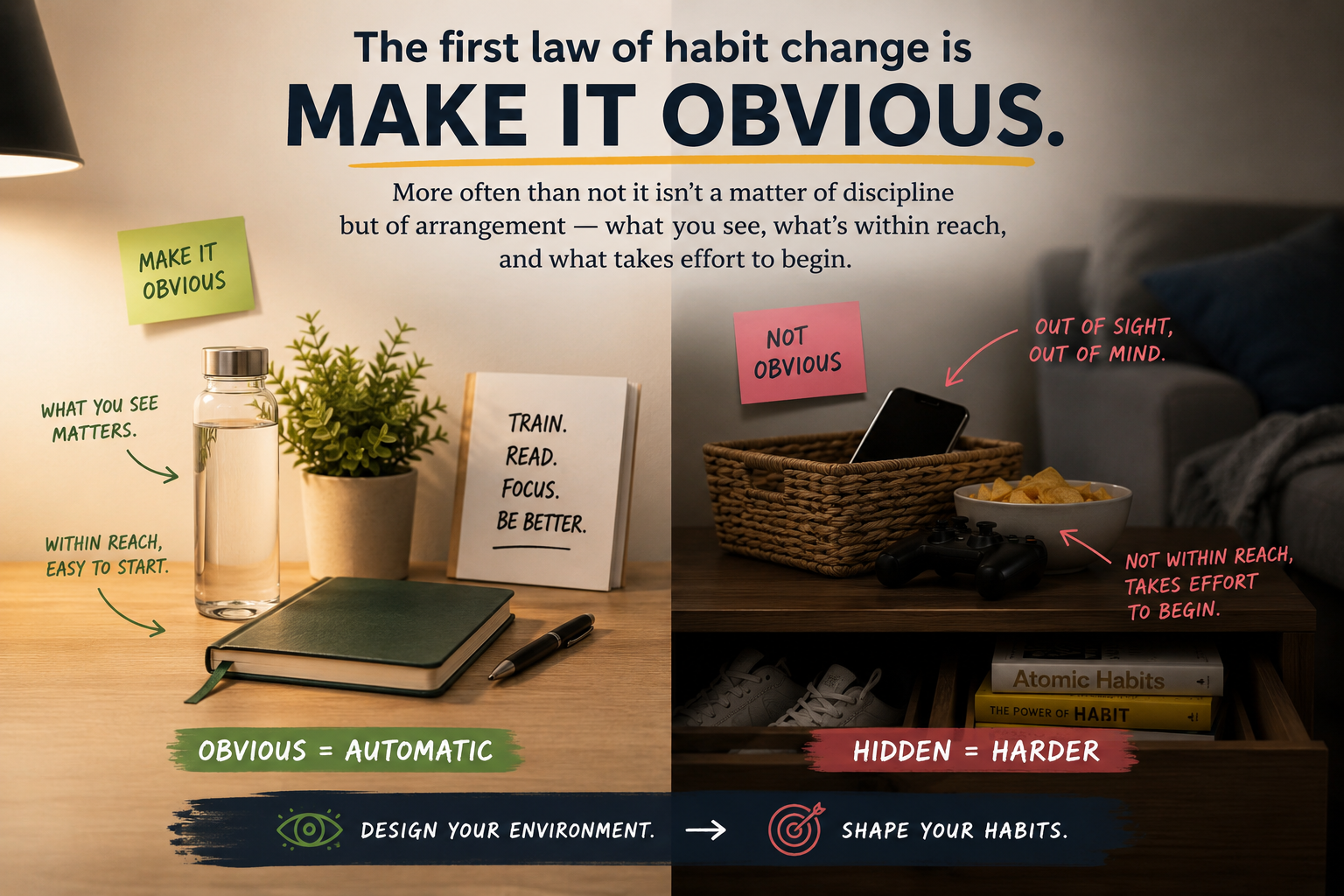
The first of the four laws of behavior change is "make it obvious." In practice that's not a motivational slogan but an engineering task: arrange the space so the useful action is visible and within reach, and the harmful one is hidden and slightly annoying to start.
The examples at home are mundane, but they hold. A guitar on a stand instead of in its case means I pick it up in passing; zipped away in a cupboard, it may as well not exist. The phone in another room during focused work removes a cue that would otherwise tug at me fifty times. Gym clothes laid out the night before drop the morning threshold to zero. None of this asks for more discipline — it asks for a better layout.
The reverse direction matters just as much. A bad habit is rarely "beaten" by willpower; it's made invisible and inconvenient. Logging out of an app, unplugging a cable, moving the thing out of sight — each adds a little friction at exactly the moment the impulse peaks. And the impulse seldom survives even a minute of delay.
There's a quieter layer underneath all of it. Every visible cue is a small vote for who you are. The guitar out on its stand says "I'm someone who plays"; the running shoes by the door say "I run." So the environment isn't just a trigger for action — it's a slow ballot for identity. You design the space, and over time it redesigns you.
When I built SamsaraForge, this exact law became mechanic rather than decoration: the app pushes the next action to the front and keeps it visible, because what you don't see doesn't happen. The mechanics sit directly on the four laws, and "make it obvious" is the first one you reach.
We think we need more willpower. Usually we need a better environment. Code doesn't get more reliable because I scold it — it gets reliable when I fix its surroundings. With people, it turns out, it's no different.
Comments (0)