
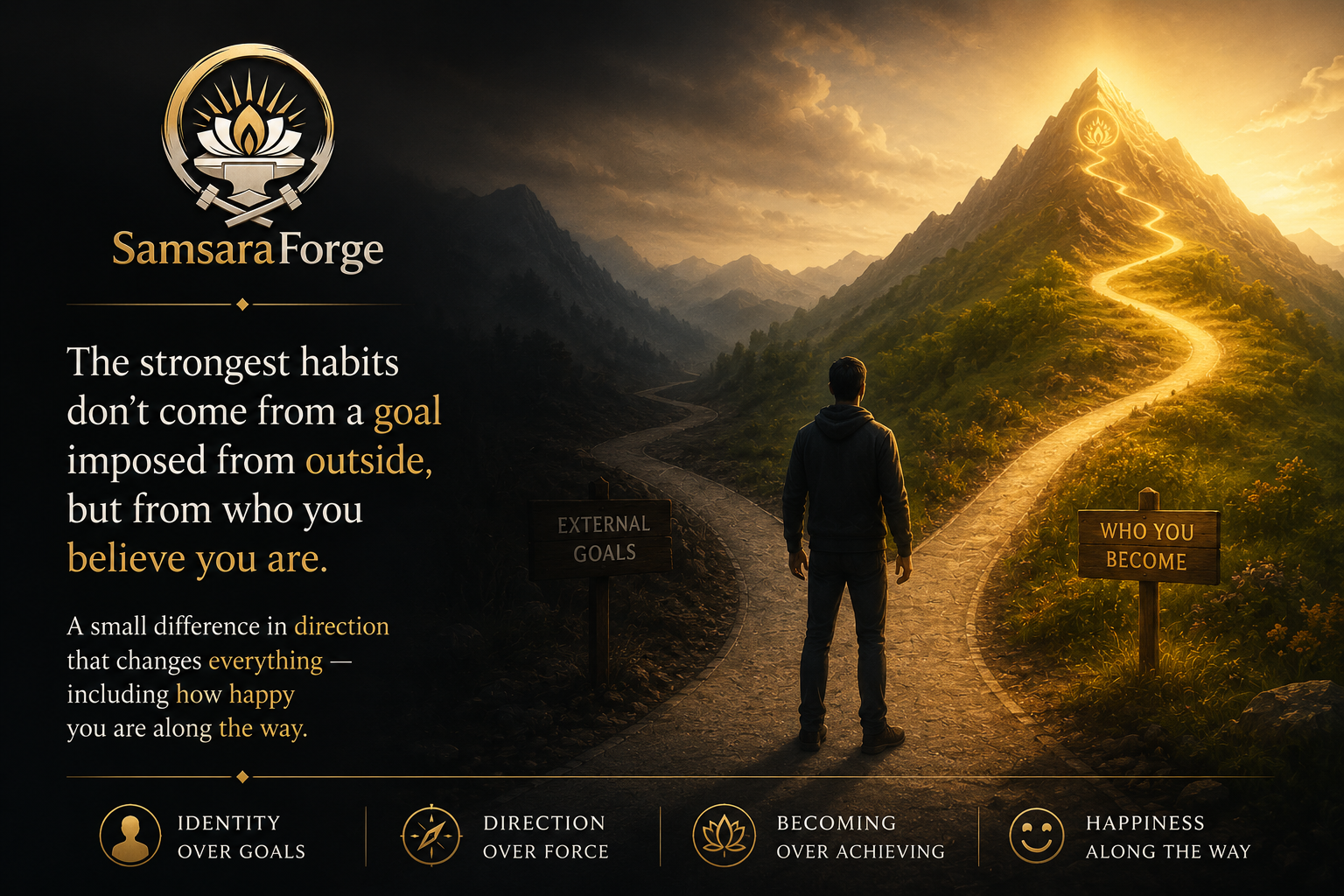
Why Lasting Habits Come From the Inside Out
I've started dozens of habits that didn't survive. Workout routines, waking up early, keeping a journal — each began with strong desire and faded within two weeks. For a long time I thought the problem was discipline, that I simply wasn't tough enough. Only later did I realize the direction was wrong.
In Atomic Habits, James Clear describes three layers of change: outcomes, processes, and identity. Outcomes are the outermost layer — what you want to achieve. Identity is the innermost — who you believe you are. Most people start from the outside: they set a goal and try to impose it on themselves. „I want to lose weight." „I want to write a book." The goal comes from the outside in.
The opposite direction looks almost identical in words but works completely differently. Not „I want to run every day," but „I'm someone who takes care of their body." Not „I want to write," but „I'm someone who writes." The goal no longer hangs in front of you like a reward you haven't yet earned. It describes who you are now.
Every action is a small vote for who you believe you are.
Here something psychology has long described comes into play. When the goal lives outside you, the only fuel is willpower — and willpower is a finite resource. Every day you fight yourself, and sooner or later you lose. When the goal lives inside, in your very image of yourself, the action stops being a battle. It simply confirms something already true. A feedback loop forms: belief drives action, action reinforces belief. A cycle that feeds itself — unlike willpower, which only depletes.
This is also the difference between extrinsic and intrinsic motivation. The extrinsic kind — approval, a result, a number on the scale — pulls from outside and demands a constant supply of energy. The intrinsic kind doesn't push; it draws from within. It's no accident that the habits which survive are almost always the second kind.
And here's the less obvious part: this approach doesn't just work better, it makes you happier along the way. When you fight a goal from outside, every day is a small defeat until you reach it — and the reward waits at the finish line, if you get there at all. When you act from identity, the reward is in the action itself. You're not proving anything to the world; you're simply in agreement with yourself. The internal friction between what you do and who you believe you are disappears. And a great deal of unhappiness comes from exactly that friction.
This very principle is built into SamsaraForge — not as outside inspiration, but into its mechanics themselves. The name comes from samsara — the loop we repeat over and over without escaping it. Leaving the loop doesn't happen through more willpower from outside. It happens when you change who you believe you are — and the system is built so that your daily actions quietly vote for that person, instead of chasing a distant goal.
For a long time I saw myself as an engineer who builds systems. Psychology taught me that the most important system a person designs is their own identity — and that it, too, is built from small, repeated actions.
Comments (0)