
The Decision You Only Make Once
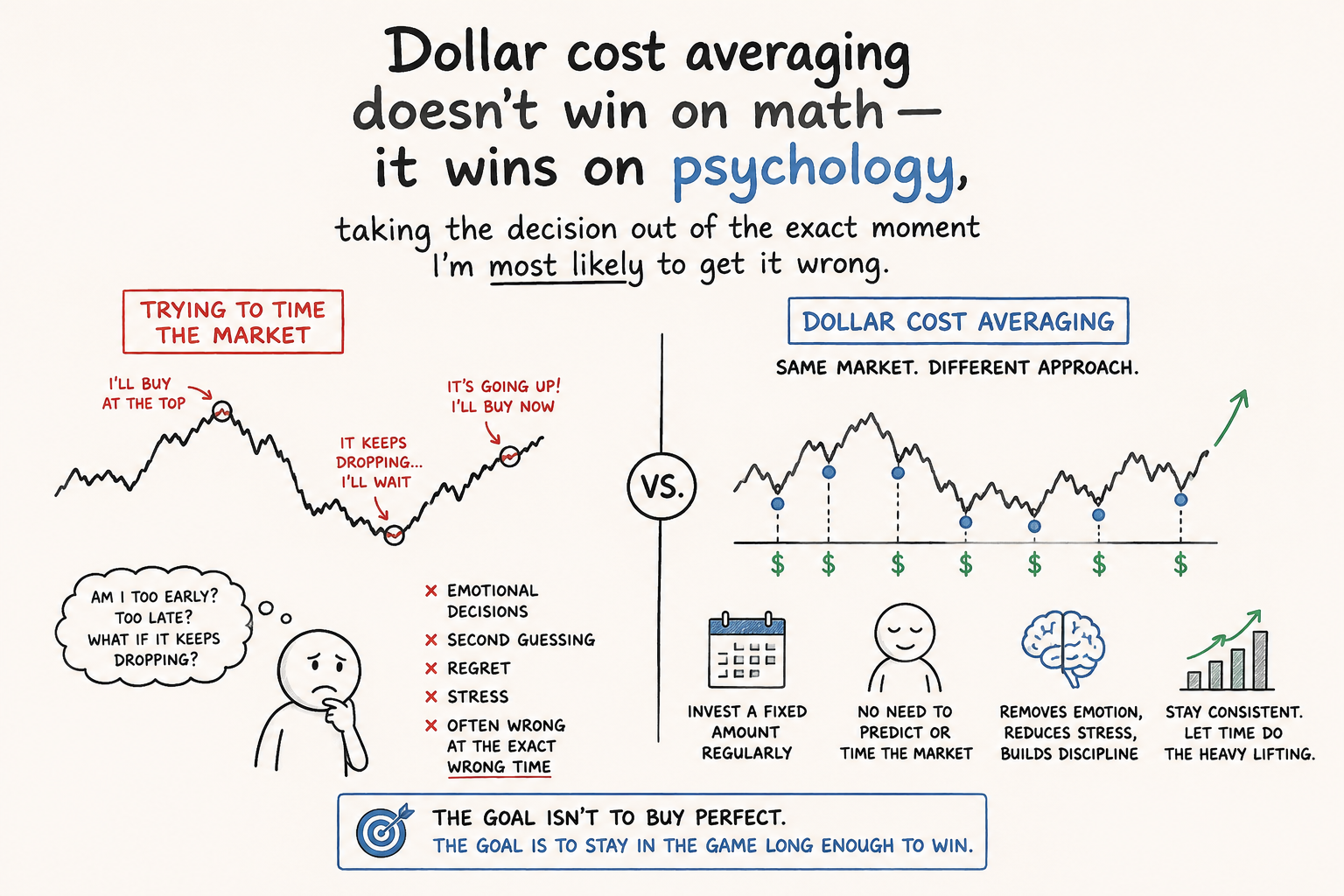
I don't know where the market goes next month. Nobody does — some people just sell the guess more convincingly. Dollar cost averaging starts from exactly that admission: you invest a fixed amount at a fixed interval and stop asking whether the moment is right.
The mechanics are boring, and that's the point. Say $200 on the first of every month, whatever the price. When it's low, the same money buys more shares; when it's high, fewer. Over time the average price you paid smooths itself out.
Here's the honest part that rarely gets said: the math isn't the strongest argument. If you already have the lump sum, investing it all at once statistically beats averaging more often than not — markets trend up over the long run, and time in the market wins. DCA doesn't maximize returns.
So why do it? Because I'm not a spreadsheet. The value isn't mathematical, it's psychological. DCA takes the decision out of the exact moment I'm most likely to get it wrong — when the market is falling and fear says wait, or when it's climbing and greed says put everything in now. You decide once, and the rule runs without asking you again.
The irony is that the month the market drops 15% is precisely the month averaging quietly buys more — and precisely the month I'd want to skip the contribution. The rule is smarter than me exactly because it feels nothing. It doesn't read headlines, doesn't panic, doesn't get excited. It does what we agreed on.
To me it looks like a scheduled job. Idempotent, dull, running regardless of the news. The whole reason you take a human out of the critical path is that the human is the unreliable part. Here I'm doing the same thing to my own worst instincts — moving the decision from a moment of emotion to a moment of calm, once, in advance. It's the same reason I built Investify — something steadier than me on my worst day.
The best system isn't the one that's smartest in the moment. It's the one that keeps working when I'm not at my best.
Comments (0)