
A Kodály Game: The Sound Ladder
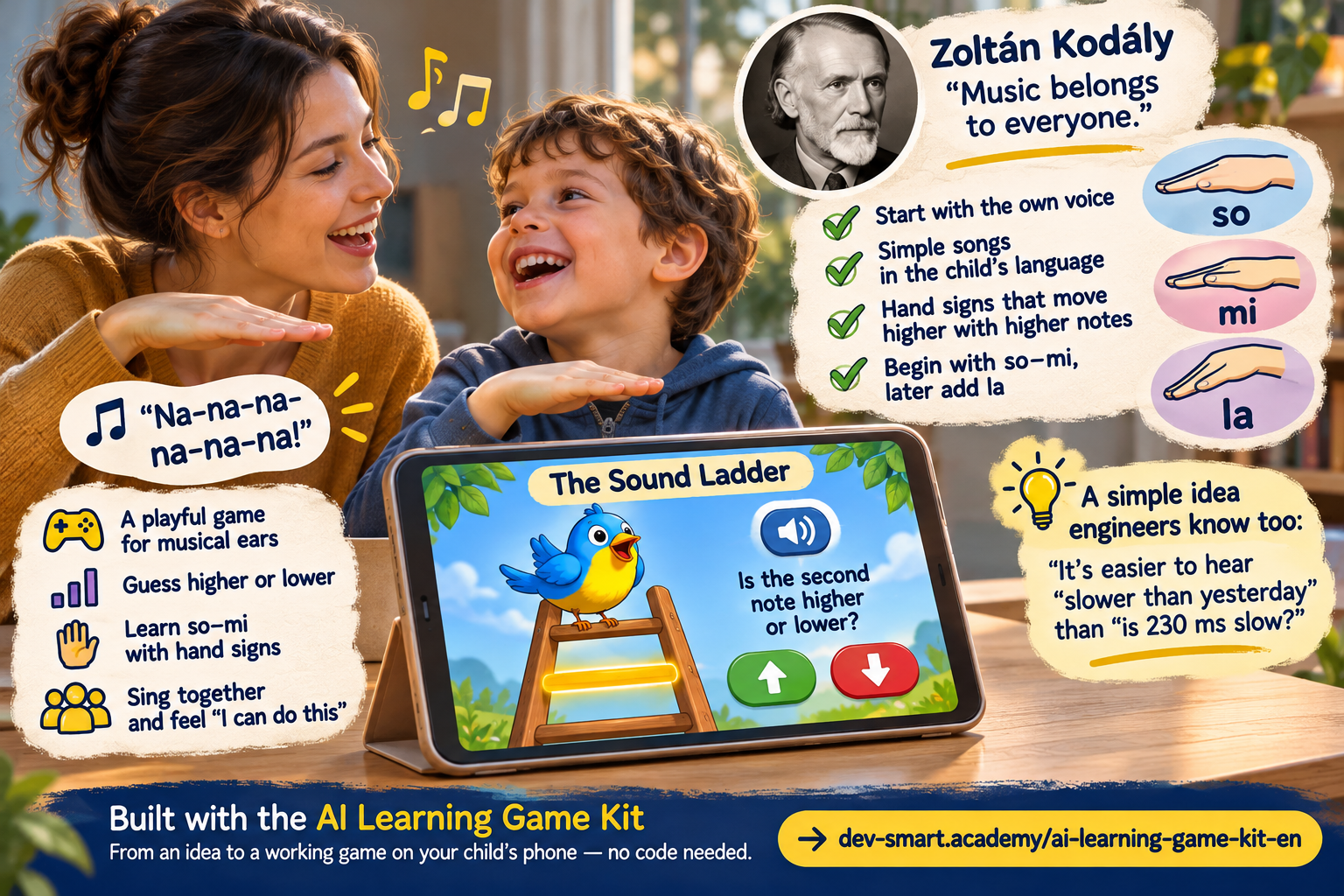
Children on playgrounds all over the world tease each other with the same tune. "Na-na-na-na-na-na." Two notes, one a little higher than the other. Nobody taught them. And exactly those two notes are where one of the best-known methods of music education in the world begins.
Who Kodály was
Zoltán Kodály was a Hungarian composer, born in 1882. Together with Béla Bartók, he travelled around Hungarian villages with a phonograph and recorded thousands of folk songs. He died in 1967.
Kodály believed music shouldn't be only for the gifted and for people who could afford piano lessons. "Music belongs to everyone," he said. And the instrument every child has is the voice. So in his view, music education should start with singing, with songs in the mother tongue, as early as nursery school.
Kodály himself didn't write a method. His students and colleagues built it from his ideas in mid-20th-century Hungary. Today it's taught all over the world.
So and mi
The method uses a few simple tools. One is relative solfa: notes have names, do, re, mi, fa, so, la, ti, but they aren't tied to a fixed pitch. "Do" is wherever the song's home is. That way a child learns the relationships between notes, not their absolute pitch.
Another tool is hand signs, which Kodály borrowed from the 19th-century English teacher John Curwen. Each note has its own hand position. When the note is higher, the hand is higher. The child sees and feels with their body what they hear.
And the first two notes children start with are exactly the ones from the playground: so and mi. Then la is added. Step by step, from what the child already knows.
The engineering side: compare to the baseline
Few people have perfect pitch: hearing a single note and saying "that's an A". But almost anyone can say whether a second note is higher than the first. Relative is much easier than absolute.
Engineers know this from measuring speed. "Is a 230-millisecond request slow?" Hard to say. "Is it slower than yesterday?" That's easy. That's why we always compare to a baseline: the previous version, last week. Kodály's relative solfa is exactly that: not "how high is it?" but "is it higher than the last one?"
The game: "The Sound Ladder"
The learning goal is for the child to hear which note is higher and which is lower, then recognise so and mi, and finally sing them. This is one of the few games in the series where sound is essential.
- High or low? The screen shows a ladder with a little bird on one rung. The game plays two notes, one after the other. It asks: "Is the second one higher or lower?" Two big buttons with arrows pointing up and down. Then the bird hops up or down the ladder, exactly as far as the difference. If your child chose the other one, the bird still hops the right way. Your child sees the answer.
- Smaller differences. At first the notes are very different. Then the difference gets smaller. The bird hops less.
- So and mi. The game plays the playground tune: so, mi, so, mi. The bird hops between two rungs. Pictures of the hand signs for so and mi appear next to the rungs.
- Sing with your hands. The game shows a card for the parent: "Sing so-mi with hand signs. Your child repeats." The phone doesn't listen and doesn't record. It only plays the notes if you need them.
- La. When so and mi feel easy, la is added, one rung above so. Now the tunes have three notes.
How to make it with the AI Learning Game Kit
This game is made with the AI Learning Game Kit. Choosing between "higher" and "lower" is the job of the "Pick the Correct Answer" foundation. The ladder and the bird are a small addition on top.
- Upload the workspace from the kit to ChatGPT Work and add the AI Parent Game Coach skill. It takes the foundation, checks it and prepares it for a phone.
- Paste the prompt below. It describes the game the way a parent would. The skill takes care of the rest.
- Try the game and say what to change, such as "a softer sound" or "slower". Then repeat.
- When you're happy, follow the publishing guide in the kit until the game is an icon on your phone.
The prompt
Use $ai-parent-game-coach and the "Pick the Correct Answer"
foundation to build a new game for my child.

Child: 4–7 years old.
Learning goal: hearing which note is higher and which is lower,
recognising the notes so and mi, and singing them with hand signs.
Idea: based on Zoltán Kodály: music belongs to everyone, the voice is
the first instrument, relative solfa and hand signs.
Language: English and Bulgarian.
Session: about 10 minutes.

This game needs sound. The notes are soft and calm (like a piano or a
flute), not shrill.

The screen: a ladder with 8 rungs and an original little bird on one
rung.

Level 1, "High or low?": the game plays two notes one after the
other. The question "Is the second one higher or lower?" with two
large arrow buttons. Then the bird hops up or down as many rungs as
the difference, whatever my child chose. No "wrong". An "Again"
button replays the two notes. First big differences, then smaller.

Level 2, "So and mi": the game plays so-mi-so-mi. The bird hops
between two rungs. Next to them, pictures of the Curwen hand signs
for so and mi.

Level 3, "Sing with your hands": a card for the parent "Sing so-mi
with hand signs. Your child repeats." A "Listen" button plays the
notes.

Level 4: la is added (one rung above so). Short three-note tunes: my
child shows them with the bird on the ladder.

The game does NOT use the microphone and does NOT record. No points,
stars, timer or "well done". Large buttons, works on a phone. No ads,
accounts or data collection.

Then get it ready so I can open it on my phone and publish it.
One note. Check the hand signs. The AI sometimes draws them inaccurately, and so and mi have standard hand positions. If you're not sure, look up a picture of "Curwen hand signs" and compare. And check that the notes really are so and mi, not just any two notes.
Honest about the limits
You may have heard that music makes children smarter. In 1993 a study by Frances Rauscher and colleagues, known as the "Mozart effect", showed that university students did slightly better on a spatial task after listening to Mozart. The effect was small and lasted minutes, but the idea spread as "Mozart makes babies smarter". Later checks found nothing much.
And what about learning music, not just listening? Meta-analyses by Giovanni Sala and Fernand Gobet in 2017 and 2020 show that when studies are well designed, music training hardly improves intelligence, reading or maths. The effects seen in weaker studies disappear in stronger ones.
That's no reason not to teach your child music. Quite the opposite. Music is worth it for its own sake: the joy of singing, grandma's songs, the feeling that you can do it. Kodály never promised a higher test score. He promised that music belongs to everyone. And the Kodály method itself, as a method, has been studied very little. It's more a tradition than a proven system.
So the best follow-up to this game is a song. A children's song you know, sung together. Hands up when the tune climbs, down when it falls.
Music doesn't have to make a child smarter to be worth it. It's enough that it makes them happy.
Comments (0)