
A Kapur Game: Try First, Then I'll Show You
In the article on John Sweller, I wrote that beginners learn best when they first see a worked example. Show how, then let the child try alone. That's well researched and it works. Manu Kapur, though, asks an awkward question: what happens if we reverse the order?
Who Kapur is
Manu Kapur is a learning scientist, born in India. He worked for many years in Singapore, at the National Institute of Education, and is now a professor at ETH Zurich in Switzerland. He studies how students learn maths and when difficulty helps.
Productive failure
In 2008 Kapur ran an experiment with students in Singapore. One group got a lesson on a new topic and then solved problems. The other group first got a hard problem on the same topic, with no lesson. The students tried, came up with their own methods, and most didn't reach the right answer. Only then did the teacher show them the correct method.
On the test afterwards, both groups did equally well on the standard problems. But the second group, the one that had first "failed" the problem, did better on problems that required understanding and transfer to something new. Kapur calls this productive failure.
His explanation is that the attempt, even a failed one, does two things. The child notices what they don't know. And when they then see the correct method, they understand why it's correct, because they've tried other methods and seen where those break.
The engineering side: try the library first
Every developer knows this. You read the documentation for a new library before you've tried it, and nothing sticks. It all seems sensible, but you don't understand why it's built that way. Then you try it yourself, something doesn't work, you puzzle over it for an hour, and you go back to the documentation. Now every sentence is clear. You know exactly what problem it solves.
That's why many teams run a short experiment before a big decision: a quick prototype we know we'll throw away. It almost never does the job. But afterwards we understand the problem much better, and the right solution looks obvious. That's Kapur's productive failure, software edition.
The game: "Measure the Dragon"
The learning goal is measurement: understanding that to compare two lengths, you need equal units, laid out with no gaps and no overlaps. But the game doesn't start there. It starts with a problem.
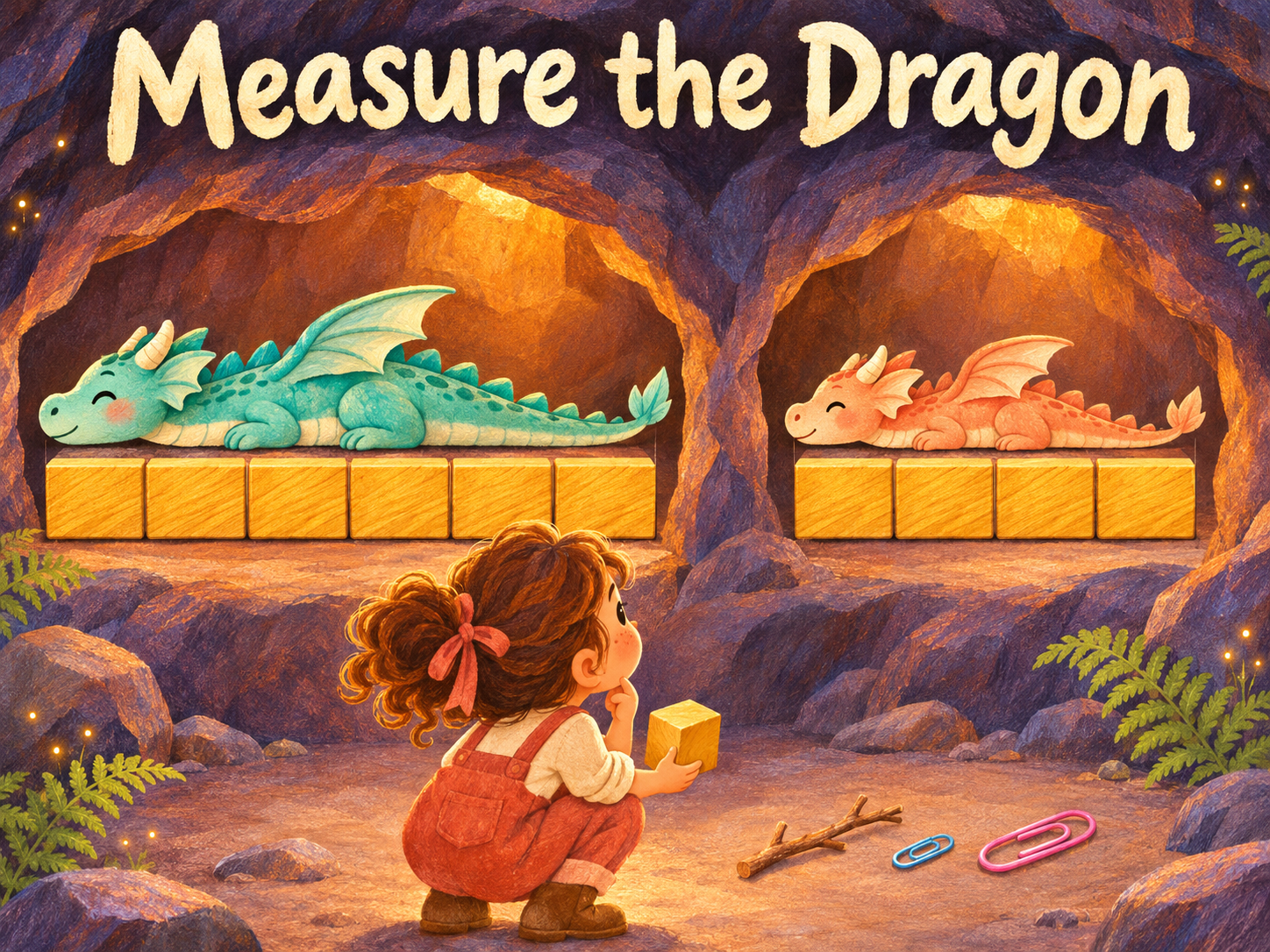
- The problem. There are two dragons, each in its own cave. They can't be put side by side. The game asks: "Which dragon is longer?" And it gives your child a toolbox: a little hand, sticks of different lengths, paper clips in two sizes, and a piece of string.
- Invent a way. Your child drags the tools along each dragon however they like. They might measure one with hands and the other with paper clips. They might leave gaps or overlap. The game says nothing. It only counts: "Five hands", "Seven paper clips".
- Which is longer? Your child answers. Then the game says calmly: "Hmm. With the hands it comes out one way, with the paper clips another. I wonder why?" And it shows your child's attempts side by side. The gaps light up. The overlaps light up. The different sizes light up.
- Here's how people do it. Only now does the game show the method: equal blocks, side by side, with no gaps and no overlaps, starting right at the end. Your child measures both dragons this way and sees which is longer. Now the answer is clear, and your child knows why the first attempts didn't work.
- A new problem. Finally, a card for the parent: "Measure the table and the bed with spoons. Which is longer? Watch out for gaps."
The most important thing is that there's no "wrong" in the first part. Your child doesn't fail. They try. Failure is productive only if it's safe.
How to make it with the AI Learning Game Kit
Measuring by dragging objects is a new mechanic, so this game is built on the "Learning Game" foundation from the AI Learning Game Kit, like the fish tank, the Gopnik machine, the DeLoache map and the Tversky drawing game.
- Upload the workspace from the kit to ChatGPT Work and add the AI Parent Game Coach skill. It takes the foundation, checks it and prepares it for a phone.
- Paste the prompt below. It describes the game the way a parent would. The skill takes care of the rest.
- Start with one tool, the blocks, to check the measuring works. Then add the mixed tools and the first stage.
- When you're happy, follow the publishing guide in the kit until the game is an icon on your phone.
The prompt
Use $ai-parent-game-coach and the "Learning Game" foundation to build
a new game for my child. This is a new mechanic, so start with the
smallest version that works.

Child: 5–8 years old, counts to 20.
Learning goal: measurement: to compare two lengths, you need equal
units, laid out with no gaps and no overlaps, starting from the very
end.
Idea: based on Manu Kapur and "productive failure": the child first
tries to solve the problem alone, and only then sees the correct way.
Language: English and Bulgarian.
Session: about 10 minutes.

The screen: two original dragons of different lengths, each on its
own half of the screen (they can't be moved next to each other).

Stage 1, "Invent a way": the question "Which dragon is longer?". A
toolbox: a little hand, sticks in 3 different lengths, small and
large paper clips, a piece of string. My child drags tools along each
dragon freely, however they like. The game only counts aloud what's
been laid out ("Five hands"). No hints and no "wrong".

Stage 2, "Which is longer?": my child picks a dragon. Then "Hmm. I
wonder why it comes out differently?" and my child's attempts are
shown side by side. Gaps, overlaps and different sizes glow softly.

Stage 3, "Here's how people do it": equal blocks, side by side, with
no gaps and no overlaps, from the very end. My child measures both
dragons this way. The answer is clearly visible.

Stage 4: a card for the parent "Measure the table and the bed with
spoons. Which is longer? Watch out for gaps."

No points, stars, timer, "well done" or "wrong". Large tools, works
on a phone, everything makes sense without sound. No ads, accounts or
data collection.

First build stage 3 with the blocks, so the measuring works. Then
stages 1 and 2. Finally, get it ready so I can open it on my phone
and publish it.
One note. The AI will want to help in the first stage, for example by arranging the tools itself or giving a hint. Don't let it. The whole idea is that your child tries first without help. The help comes in stage 3, not before.
Honest about the limits
There's a real debate here. Sweller and his colleagues, whom I wrote about in an earlier article, say that solving new problems without help overloads beginners. Kapur says that sometimes exactly this prepares for deeper understanding. Who's right?
A 2021 meta-analysis by Tanmay Sinha and Kapur gives a partial answer. Productive failure helps understanding and transfer to new problems, but not the procedures themselves. And it helps only when it's done well: when the teacher then carefully compares the students' attempts with the correct method. Without that step, failure stays just failure. Ido Roll, Katharina Loibl and colleagues reached a similar conclusion in a 2017 review.
Second, almost all the research is with secondary school students, mostly in maths. Productive failure has been studied very little with young children. That's why in this game the "failure" is short, safe, and followed straight away by a clear demonstration.
The truth is probably that both Sweller and Kapur are right, about different things. When a child is learning a new procedure, an example first helps. When we want them to understand why the procedure works, a short attempt first can help more.
A child who has tried first doesn't hear the right answer as a rule. They hear it as the answer to a question they've already asked.
Comments (0)