
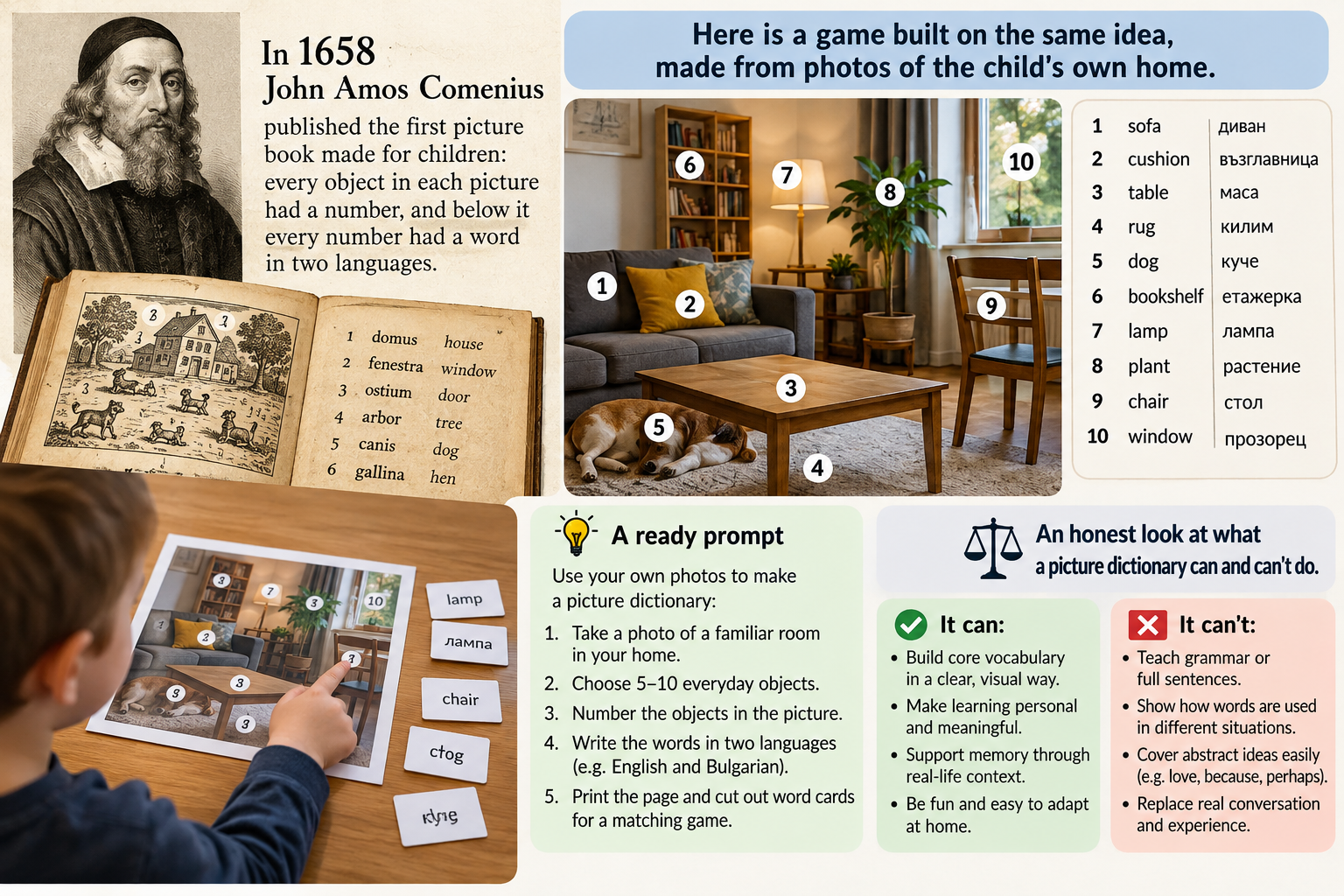
A Comenius Game: The World in Pictures, Numbered
In 1658 an unusual children's book came out in Nuremberg. Every page had a picture, and on the picture small numbers sat next to the objects: a tree, a bird, a bucket, a fire. Below the picture each number had a word, in Latin and in German. Today we'd call it a picture dictionary. At the time it was something new. It was called "Orbis Sensualium Pictus", "The Visible World in Pictures", and it is often described as the first picture book made especially for children.
Who Comenius was
John Amos Comenius was a Czech educator and clergyman, born in 1592 in Moravia. He spent much of his life in exile because of the Thirty Years' War and died in Amsterdam in 1670. In "The Great Didactic" he wrote something radical for his time: school is for all children, rich and poor, boys and girls.
His principle for learning was simple: things first, then words. A child should see, touch and hear before learning what something is called. "Orbis Pictus" was his attempt to put the world in front of the child when the world itself wasn't close by.
Why it works
Psychology confirmed Comenius three centuries later. In the 1970s Allan Paivio described dual coding: a word linked to an image is remembered better than the word alone. Related to it is the picture superiority effect: pictures are remembered more easily than the words that name them.
We'll add one step Comenius couldn't take. The pictures won't be of a faraway world, but of the child's own kitchen and room. Their cup, their chair, their toy. In the first article of this series I wrote about the self-reference effect: we remember better the things that are about us. Here it works together with dual coding.
The engineering side: a labelled dataset
If you work in machine learning, you'll recognise "Orbis Pictus" at once. It's a labelled dataset: images, objects marked on them, and a label for each object. ImageNet, which much of modern computer vision grew out of, is the same idea with millions of photos. Comenius made his by hand, with engravings.
In this game the child does exactly that. They mark objects on a photo and give them labels in two languages. A child isn't a model and doesn't learn like one. But the pair "image and word" sits at the base of both kinds of learning, and it's good for a child to see that machines learn from pairs like these too, made by people.
The game: "My Orbis Pictus"
The learning goal is vocabulary in a second language for the objects around the child. In the example the second language is Spanish, but it can be any language your family is learning.
- Photo. Together you photograph a corner of your home: the kitchen table, the toy shelf, the window. No people in the photo.
- Numbers. Your child taps the objects they choose, and a numbered circle appears on each spot, from 1 to 10. They decide what matters, not you.
- Words. For each number you type the word in both languages. A speaker button says the second-language word aloud.
- "Show me". The game says a word, for example "taza". Your child taps the circle. If it's the same one, the word sounds again and the circle glows. If not, the right spot pulses gently and the word sounds again. As in the Skinner article: immediate feedback about the task, with no points or praise.
- "Say it". One circle lights up and your child says the word aloud before hearing it.
- The book. The pages pile up. Each can be printed like a leaf from "Orbis Pictus": the photo with the numbers on top and a numbered list with both words below.
After a few weeks you have a book nobody else has. Your child's world, in two languages, with the numbers they placed.
The prompt
Build a small web app as a single self-contained HTML file: a
bilingual picture dictionary based on the idea of John Amos
Comenius's "Orbis Pictus". Interface language: English.
Second language: [Spanish].

Creating (parent and child together):
- A "New page" button: upload or take a photo of a room or a
  corner of the home. The photo is processed in the browser only
  and is never sent anywhere.
- The child taps objects on the photo and a numbered circle
  (1, 2, 3…) appears on each spot, up to 10 per page. A long press
  removes a circle.
- For each number the parent types the word in English and in the
  second language. A speaker button speaks the second-language word
  with speechSynthesis (a voice for that language).

Play on one page:
- "Show me": the game speaks a second-language word; the child taps
  a circle. If it matches, speak the word again and let the circle
  glow for a second. If not, the right spot pulses gently and the
  word is spoken again. The task returns after 2 others.
- "Say it": one circle lights up; the child says the word aloud,
  then taps the speaker to hear it.
- No points, stars, "well done" or "wrong", no error sounds.

The book:
- Pages are kept on the device only (IndexedDB) until the parent
  deletes them.
- "Print": each page as a sheet with the photo and numbers on top
  and a numbered list with both words below.

Design: calm colours, large circles and buttons, works on a phone,
no ads, no external requests and no data collection.
Two technical notes. Saving pages works on the phone itself, but in the preview inside the chat it sometimes doesn't, so try the app on the device it will be used on. And if the second-language voice sounds odd, check in the phone's settings which voices are installed.
Honest about the limits
A dictionary isn't a language. Ten nouns from the kitchen don't make a sentence. Comenius knew this himself: "Orbis Pictus" was a beginning, not a goal. Real language comes when the words get used. Asking for the cup in the new language at the table teaches more than ten taps on the circle with the cup.
Pictures also show objects most easily. Verbs, feelings and the links between things need something else: a story, role play, conversation. For those, see the Reggio Emilia and Waldorf games in this series.
And a note about the photos. Photograph things, not people, and especially not children. The game doesn't need a face to be personal. It's personal because the cup belongs to your child.
Comenius isn't one of the six in the book from the AI Learning Game Kit, but the kit does the same job for the part after the prompt: from a working app to an icon on the phone.
Comenius didn't invent new words. He invented the small number that links a word to a thing. Sometimes that is all of learning.
Comments (0)