
A Clay Game: The Finger That Reads
Give a three-year-old a book upside down. Many children will start "reading" it quite happily, back to front, telling the story from the pictures. Show them a sentence and ask them to point to one word. Often they'll point to one letter. Or the whole sentence. To us these things are so obvious we don't remember learning them. But we did learn them.
Marie Clay described them more carefully than anyone else.
Who Clay was
Marie Clay was a New Zealand psychologist and a professor at the University of Auckland. She died in 2007. She spent years watching children in their first months of school, writing down everything they did with books. Two things grew out of those observations.
The first is the idea of emergent literacy. Before Clay, many people thought learning to read began when a child learned the letters. Clay showed it begins much earlier: when a child understands that a book has a front and a back, that the text "says" something, that we read from left to right and top to bottom.
The second is a test she called concepts about print. The teacher reads a small book to the child and asks: "Show me where to start reading." "Show me one word." "Show me the first letter of this word." The answers show what the child already understands before they can read anything at all.
The engineering side: where does the program start?
Give a new developer a large project they've never seen. Their first problem isn't that they don't understand the code. Their first problem is that they don't know where to start. Where's the entry point? Which way does a request flow? What's a function, what's a setting, what's a test?
Good projects have a README that says exactly that: start here, then go there. These are the concepts about print for code. An experienced developer has them so deeply that they don't remember ever not having them. Just like an adult who doesn't remember having to learn which way to read.
The game: "The Finger That Reads"
The learning goal is for the child to grasp the first concepts about print: where it starts, which way we go, what a word is, what a letter is. Not reading, but the foundation underneath it.
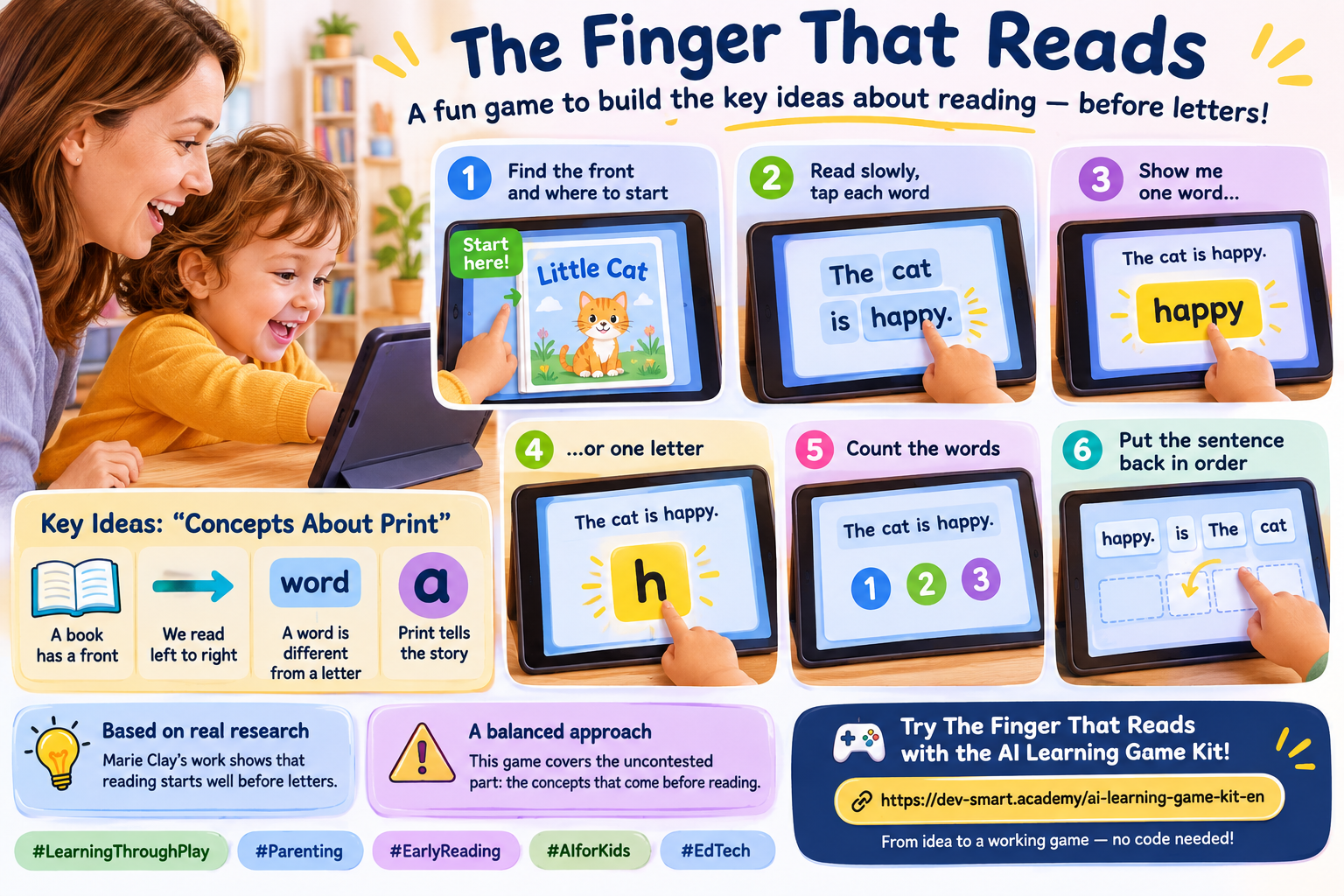
- The cover. A small book appears on the screen. The game asks: "Show me the front." Then: "Where's the title?" Your child taps.
- Where do we start? The book opens. There's a picture and one short sentence in large letters with clear spaces between the words: "The kitten sleeps on the chair." The game asks: "Show me where we start reading." Your child taps the first word.
- The finger reads. You read the sentence slowly, and your child taps each word as they hear it. The word lights up when tapped. If your child taps a different word, it lights up too, with no "wrong". You just read it again, even more slowly.
- Word or letter? The game asks: "Show me one word." Then: "Show me one letter." When your child taps a letter, only the letter lights up. When they tap a word, the whole word lights up. The difference is visible.
- How many words? "How many words are in the sentence?" Your child counts by tapping the words. The spaces between them help.
- Put it in order. Finally, the words of the sentence get mixed up, and your child puts them back in order, left to right. The sentence appears again, and you read it.
How to make it with the AI Learning Game Kit
This game is made with the AI Learning Game Kit. Putting words in order is the job of the "Sort and Match" foundation, which also supports spelling. We used it for the Elkonin sound boxes. Tapping words is a small addition on top.
- Upload the workspace from the kit to ChatGPT Work and add the AI Parent Game Coach skill. It takes the foundation, checks it and prepares it for a phone.
- Paste the prompt below. It describes the game the way a parent would. The skill takes care of the rest.
- Try the game and say what to change, such as "shorter sentences" or "bigger letters". Then repeat.
- When you're happy, follow the publishing guide in the kit until the game is an icon on your phone.
The prompt
Use $ai-parent-game-coach and the "Sort and Match" foundation to
build a new game for my child.

Child: 3–6 years old, doesn't read yet.
Learning goal: the first concepts about print: the front of a book,
where the text starts, which way we read, what a word is and what a
letter is.
Idea: based on Marie Clay and her "concepts about print".
Language: English and Bulgarian.
Session: about 10 minutes.

A small book with 6 pages. On each: an original simple picture and one
short sentence (3–5 words) with very large letters and clear spaces
between words. For example "The kitten sleeps on the chair."

Stages (tips for the parent in small text at the bottom):
1. "Show me the front." and "Where's the title?": my child taps.
2. "Show me where we start reading.": my child taps the first word,
   and it lights up.
3. "The finger reads": the parent reads slowly, my child taps each
   word. The tapped word lights up. No "wrong".
4. "Show me one word." / "Show me one letter.": tapping a letter
   lights up only that letter, tapping a word lights up the whole
   word.
5. "How many words are there?": my child counts by tapping the words.
6. "Put it in order": the words get mixed up and my child drags them
   back into order from left to right. Then the whole sentence is
   shown.

The game doesn't read instead of the parent. Optionally, a "Read it to
me" button for the whole sentence.

No points, stars, timer or "well done". Large letters, works on a
phone and a tablet. No ads, accounts or data collection.

Then get it ready so I can open it on my phone and publish it.
One note. The spaces between words matter. If the first version makes them small, your child won't see where one word ends and the next begins. Ask explicitly for wide spaces, at least as wide as one letter.
Honest about the limits
Here I need to be especially honest. Marie Clay also created Reading Recovery, a programme of short one-to-one lessons for first-graders who are behind in reading. It's used in many countries. In 2016 a large US study led by Henry May showed that children in the programme made more progress by the end of first grade. But a follow-up study by the same team found something worrying. By third and fourth grade, these children hadn't just lost their head start. Their reading scores were lower than those of similar children who hadn't been through the programme.
Part of the criticism of the programme is that it encourages children to guess words from the picture and the meaning, instead of decoding them letter by letter. Research over recent decades is clear that systematic teaching of sounds and letters is the foundation of reading. That's exactly what I wrote about in the Engelmann and Elkonin articles.
This game doesn't teach reading. It only teaches concepts about print: which way we go, what a word is, what a letter is. That part of Clay's work isn't controversial. But it's only preparation. Reading itself comes from sounds and letters, not from guessing from the picture.
To us it's obvious where the text starts. But someone showed us. Now it's our turn to show them.
Comments (0)