
From Messy Notes to a Plan: Decisions, Tasks, and Who Owes What
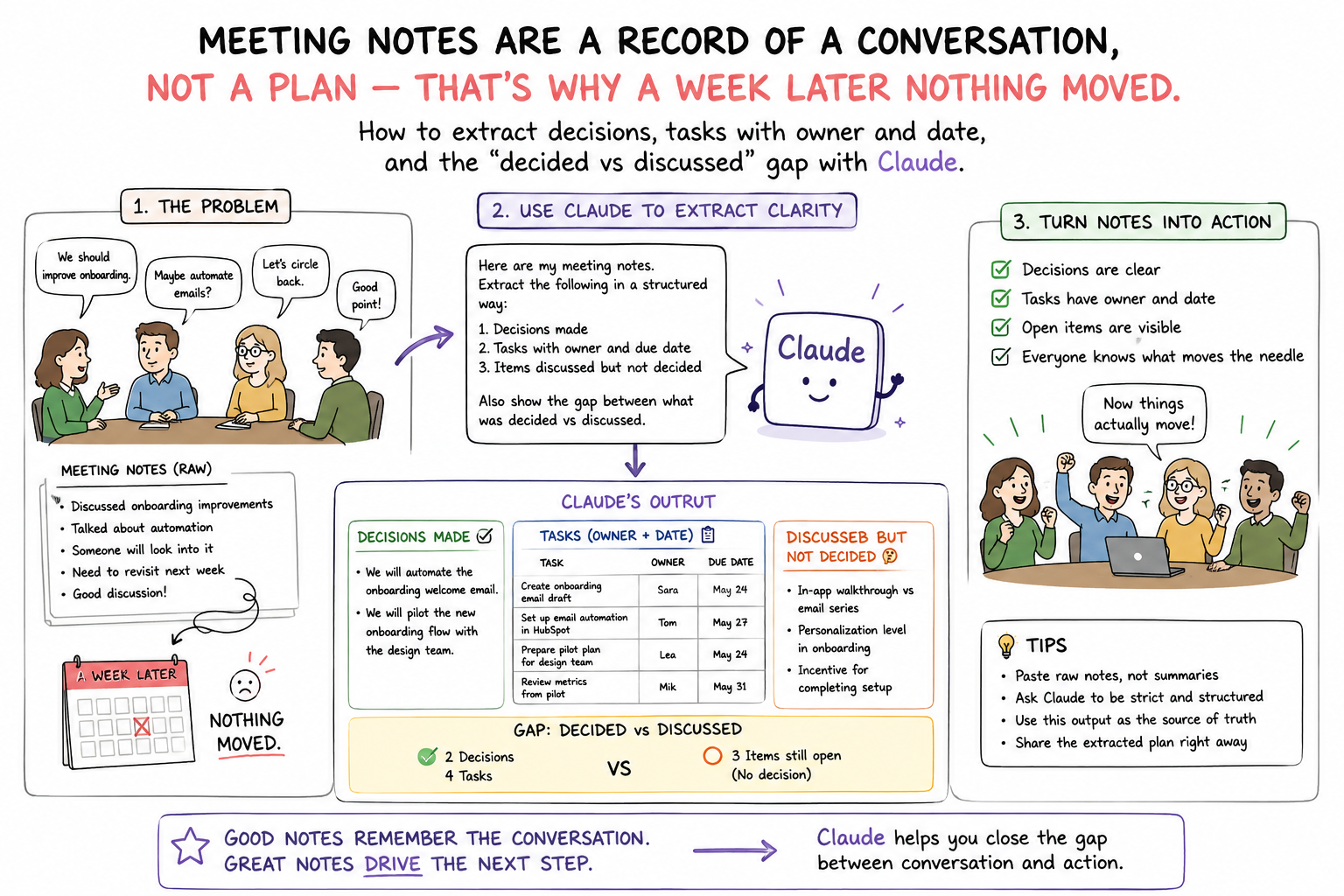
The meeting ends, everyone nods, they disperse — and a week later nothing has moved. Not because people are lazy, but because meeting notes are a record of a conversation, not a plan. They say what was said, but not what was decided, or who owes what. And that's exactly what leaks between the end of the meeting and the next one: not the topics, but the commitments.
So don't ask notes for a "summary." Ask for three separate things. First — the decisions: only what was actually decided, not discussed. Second — the action items, each with an owner and a due date. Third — the open questions: what's still hanging. A summary blends all three into a smooth narrative from which no one can later extract who does what. Separating them makes them executable.
The most important of the three is the owner rule: a task without a name is a wish. "We should check X," "someone should take Y" sounds like an action, but it's exactly where things die — because responsibility shared among everyone belongs to no one. Every task must carry one person and one date. If the notes don't contain them, that's not a small gap to skip over; it's the hole you'll feel only when it's too late.
There's a more insidious line, too — the difference between "decided" and "discussed." The most dangerous sentence in a meeting is the one everyone assumed but no one said out loud. "So we're going with option A" — was that said, or did everyone just think it? If it isn't surfaced, a week later half the team is building A and the other half is waiting for it to be decided. So explicitly separate the decided from the discussed; the silent gap between them is expensive.
Here Claude does the work, if you give it the raw notes and a clear task. Here's a prompt to copy:
Here are my messy meeting notes. Extract three things, not a
summary: 1) the DECISIONS made — only what was actually decided;
2) action items — each with an OWNER and a due date (if an owner
or date is missing, flag it as missing, don't invent one);
3) open questions and things discussed but NOT decided. If you see
a contradiction or something everyone may have assumed but no one
said clearly, point it out.
Notice the two guardrails. "Don't invent" protects against the model's most common mistake here — assembling a smooth owner and date where the notes are silent, and you taking it for truth. And asking it to surface the assumed-but-unsaid turns Claude from a stenographer into a fresh pair of eyes that sees the gaps you missed because you were inside them.
And the honest limit, because these are people's commitments. Check what's extracted against reality — Claude infers the owner from context and can get it wrong. And don't let the summary live only in your head: send it to the attendees to confirm or correct. A summary no one confirmed is a fiction that hardens into "fact" — and then someone builds on it. Five minutes of confirmation save a week of misalignment.
Because the tool can organize the record — separate decided from discussed, pull out the tasks, flag what's missing. But the commitment is people's; it's taken on with a name, a date, and a "yes, I agree," not generated. Claude gives you the clean skeleton of the plan; the flesh — that these people will actually do these things — stays your work.
Notes are a record of a conversation, not a plan. A task without a name is a wish, and "discussed" isn't "decided." Pull out the decisions, owners, and dates — and send them back for confirmation.
Comments (0)