
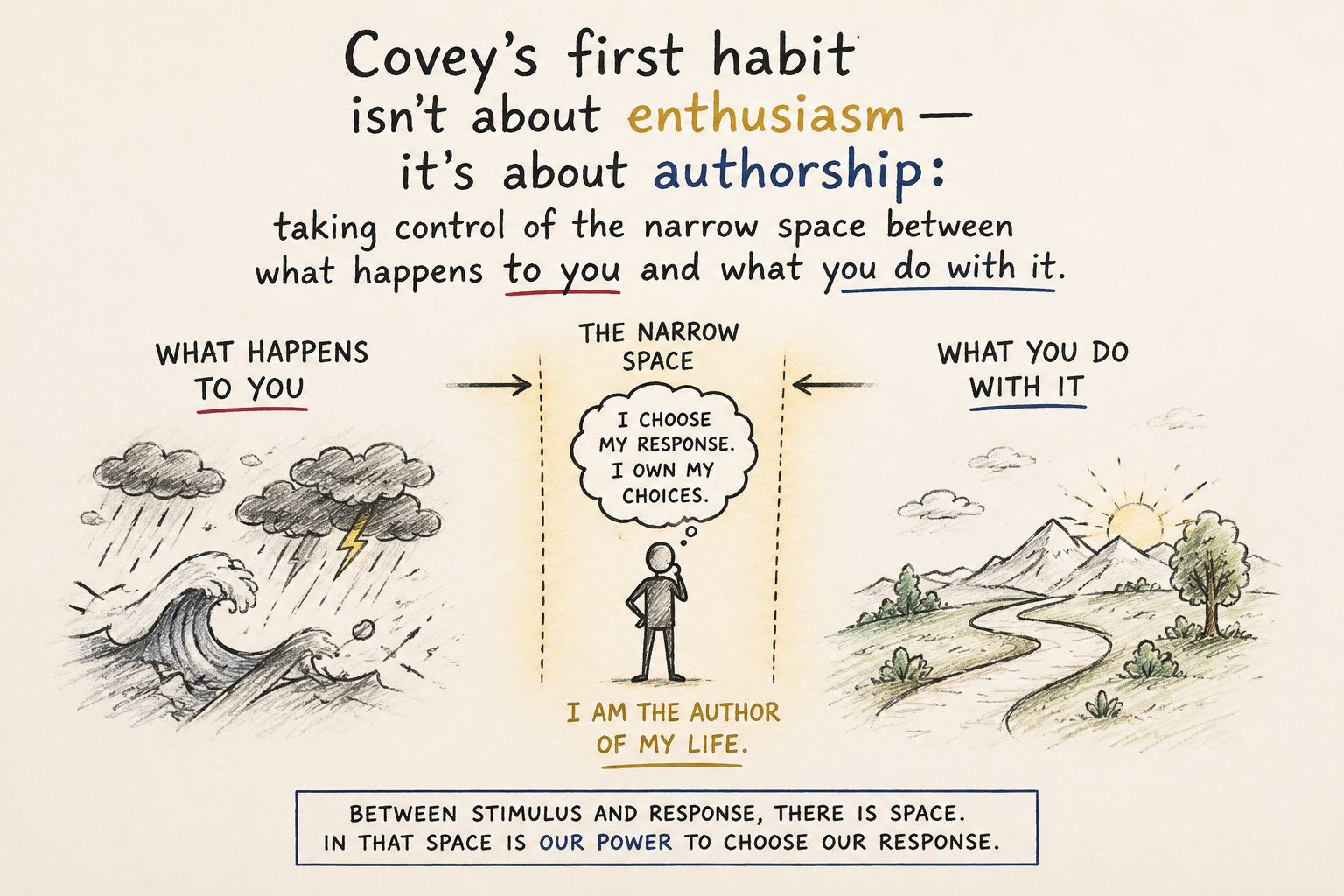
Be Proactive: The Space Between Stimulus and Response
For a long time I confused being proactive with being enthusiastic. I pictured the proactive person as the one who runs ahead, takes initiative, stays in front of the work. Covey means something quieter and more uncomfortable: the ability to choose your own response instead of having it chosen for you.
As an engineer I recognise the difference instantly. In reactive code the incoming event is wired straight to the handler — the stimulus goes in, the output comes out, and there is nothing in between that you control. Being proactive means inserting a layer between the two: a space where you decide what happens next. Covey ties this to Viktor Frankl — between stimulus and response there is a space, and in that space lies our freedom to choose. The reactive person has handed the keys to that space over to their mood, the weather, someone else's behaviour. The proactive person keeps them.
Covey adds a second picture I find even more useful: two circles. The Circle of Concern holds everything that occupies us — politics, the economy, what the boss thinks, the past. Inside it sits the smaller Circle of Influence — the things we can actually affect. Reactive people pour energy into the Circle of Concern, into inputs they can only read and never write. The effect is that their Circle of Influence shrinks. Proactive people invest in what they can influence, and that circle slowly grows.
In psychological terms this is locus of control; in engineering terms it is honest resource allocation. You don't burn compute on read-only inputs you have no write access to. You point attention at the surface you can actually change.
Language gives away which circle you live in. "I have no choice," "he makes me furious," "that's just how I am" are reactive sentences — they ship authorship outward. "I choose," "I prefer," "I'll try a different approach" bring it back to you. Swapping the language isn't positive thinking; it's admitting where control really sits.
The practical part I tried and would recommend:
- Audit your language. For three days, catch your reactive phrases — spoken and internal. Just notice them, no correcting yet. The surprise is how often you hand authorship away.
- Draw the two circles. Write your worries on paper and sort each one: concern or influence. The visual split is sobering.
- One act from the Circle of Influence. Pick a single item you have power over and do something concrete about it this week.
- Install the pause. Between trigger and reaction, insert one breath or one question: "is this my choice, or a reflex?" That is the layer missing from reactive code.
- Make and keep one promise. Small, to yourself. Response-ability trains like a muscle — by keeping tiny words.
Between the input and the output there is always a process. Being proactive is the simple, difficult decision to take authorship of it — to stop inheriting it from your mood and start writing it yourself.
Comments (0)